
The dental crown procedure, visit by visit
Most crowns take two visits about two weeks apart. At the first, the tooth is numbed, shaped and scanned or moulded, and a temporary crown goes on. At the second, the finished crown is checked for fit, colour and bite, then cemented. A practice that mills crowns in-house can do it in one visit.
What the dentist does, how long it takes, and how a crown is made in between.
Free to send, no obligation. One registered dentist rings you, not five.
- 2 visitsfor a laboratory-made crown
- About 2 weeksbetween them
- Local anaestheticthe tooth is numbed
- 1 visitwhere the crown is milled in-house
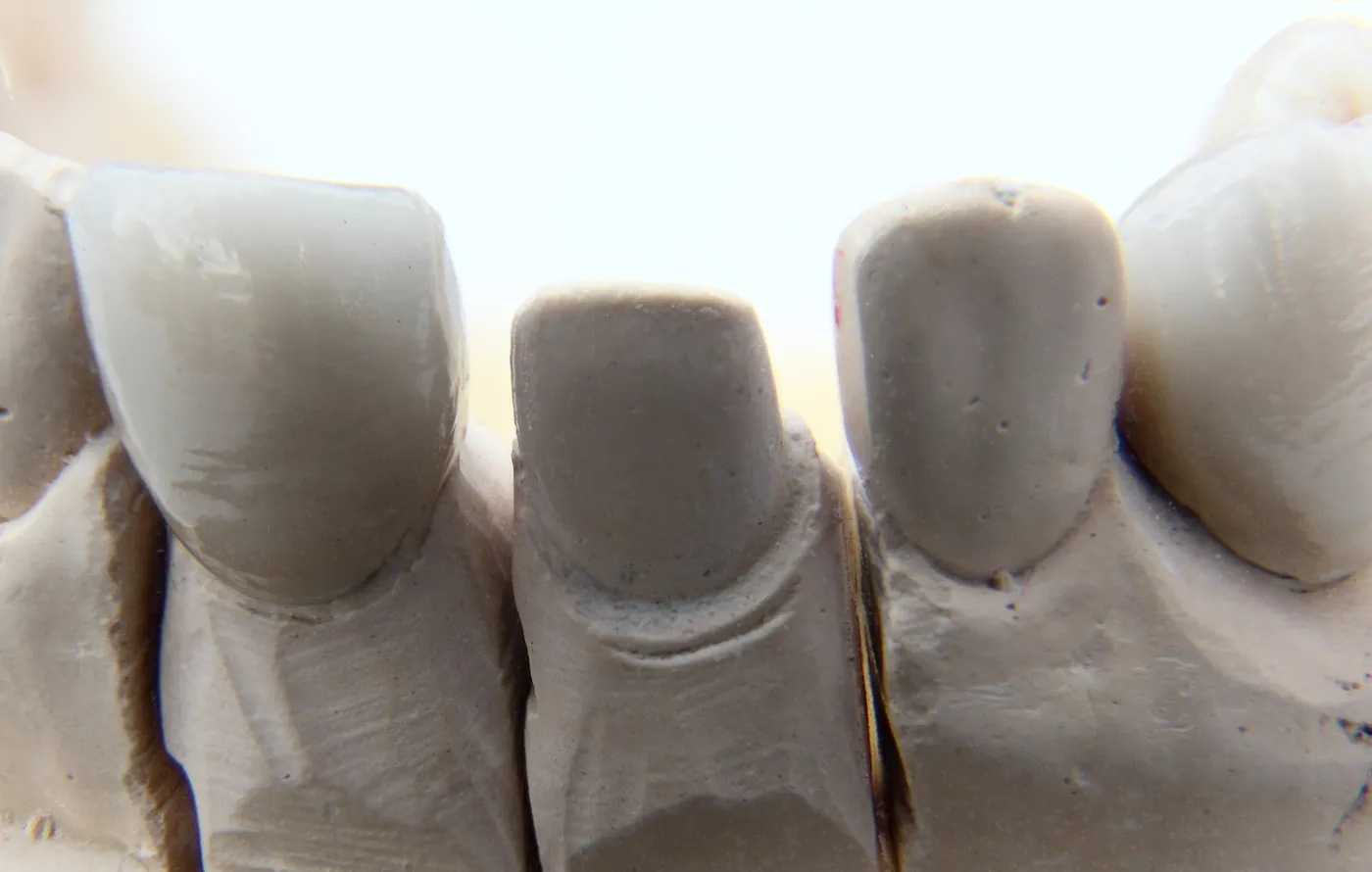
Before anything is drilled
An examination and an x-ray show how much sound tooth is left, whether the nerve is healthy and whether the root and bone are sound. You should get the plan and the price in writing, and you can ask what the other options are.
Check what your crown involves
Four quick taps. You see the kind of crown dentists most often use for that tooth, the likely cost and what's left after tax relief. Your number is only asked for at the end, if you want a price from a dentist.
Say a back tooth has cracked: that's usually a zirconia crown, €570 to €1,250 in our price guide, plus €60 to €92 for the exam and x-ray, with 20% of the crown back as tax relief.
How this is worked out
The kind of crown comes from where the tooth sits and what you tell us: all-ceramic where the tooth shows, zirconia where the chewing is heaviest or you grind, porcelain fused to metal where the price matters most, and a crown made for the implant where there is one. The prices are our price guide for Irish private practices, per tooth, plus an exam and a small x-ray. A tooth that has had root canal treatment often needs a post and core first, so that range is added to the top of the total. Tax relief is 20% of the crown and the post and core: crowns are on Revenue's list of non-routine dental treatment. It is a guide to plan with, never a diagnosis or a quote: the dentist decides after an examination and an x-ray.
The first visit, about an hour
- Numbing. A local anaesthetic around the tooth.
- Shaping. Old filling and decay come out, and the tooth is trimmed to a stump so the crown can fit over it. A badly broken tooth is built up first.
- The record. A scan with a small camera, or a mould in putty, plus a record of how your teeth bite together.
- The shade. The colour is matched to your own teeth.
- The temporary crown. A plastic crown is made in the chair and fixed with weak cement.
How dental crowns are made
The scan or mould goes to a dental laboratory. A technician designs the crown, usually on screen, and it's milled from a ceramic block or cast in metal. For a front tooth the technician may build porcelain over it by hand and fire it in a furnace, layer by layer, to copy the way a natural tooth takes the light. This takes about two weeks.
The second visit, about half an hour
- The temporary comes off and the tooth is cleaned.
- The try-in. The dentist checks the fit at the edge, the contact with the teeth either side, the colour and the bite.
- Cementing. Once you're both happy, it's cemented or bonded on.
- The bite, again. Small high spots are polished down.
Afterwards
The tooth is numbed with a local anaesthetic before it's shaped, so the work itself shouldn't hurt. Tender gum and some sensitivity to hot and cold for a few days afterwards are common. Pain that builds, or a bite that feels high, is a reason to go back to the dentist. Aftercare, day by day.
Our crown price guide
Per tooth, before 20% tax relief.
| Job | Typical cost | What moves the price |
|---|---|---|
| Porcelain fused to metal crown | €450 to €900 | The metal under the porcelain: a precious alloy costs more |
| Zirconia crown | €570 to €1,250 | Milled in one piece, or layered with porcelain for a front tooth |
| E.max all-ceramic crown | €450 to €900 | The laboratory, and how much hand finishing the shade needs |
| Gold crown | €625 to €1,100 | The price of gold on the day it's made |
| Crown on an implant | €950 to €1,235 | The crown only. The implant is priced separately |
| Onlay or inlay | €230 to €850 | Composite, porcelain or gold, and how much of the tooth it covers |
| Post and core, before the crown | €120 to €400 | A fibre post or a cast metal one |
| Re-cementing a crown that came off | €55 to €80 | Only if the crown and the tooth are both sound |
| Exam, and a small x-ray | €40 to €66, €20 to €26 | A full panoramic x-ray is €50 to €81 |
Questions people ask
How is a dental crown done?
Most crowns take two visits about two weeks apart. At the first, the tooth is numbed, shaped and scanned or moulded, and a temporary crown goes on. At the second, the finished crown is checked for fit, colour and bite, then cemented. A practice that mills crowns in-house can do it in one visit.
How long does a crown appointment take?
About an hour for the first visit and half an hour for the second. A same-day crown takes two to three hours in one visit.
How much of the tooth is removed for a crown?
Enough to make room for the crown all the way round, usually between one and two millimetres. Gold and zirconia need the least.
Is the procedure painful?
The tooth is numbed with a local anaesthetic before it's shaped, so the work itself shouldn't hurt. Tender gum and some sensitivity to hot and cold for a few days afterwards are common. Pain that builds, or a bite that feels high, is a reason to go back to the dentist.
Can I drive after a crown appointment?
Yes, after a local anaesthetic. If you have sedation, you need someone to bring you home.
Every crown guide and county
Types of crown
Guides
Check what your crown involves
Four taps to the likely crown, the cost and the tax relief. Then, if you want it, one Dental Council registered dentist who covers your county rings you.